
READ, READ, READ, READ, READ
Werner Herzog commands you


I go through books like an elephant goes through peanuts. Francis Bacon, the philosopher and scientist, wrote that “Some books are to be tasted, others to be swallowed, and some few to be chewed and digested.” I try not to choke when devouring a book.
I luxuriate in reading philosophy, but I also read the novels of Charles Portis, the poetry of John Donohue, and the nonfiction of Dr. Lindsey Fitzharris. I read things that are serious but I also indulge in the pleasures of frivolous reading; I recently perused with delight the story of a man who adopted a dog. He noticed that the pup had a tattoo on its belly, and he loved his hound so much that he had a replica tattooed on his own body. He later discovered that the tattoo meant “neutered.”
C.S. Lewis wrote that “We read to know we are not alone.” It was through the unalloyed beauty of reading that I had the joy of meeting Margaret Fuller. This polymath was a writer, teacher, Transcendentalist philosopher, foreign correspondent, and military nurse who blazed through the ferment of the mid-18th century. As a young woman in 1839, she started her “Conversations,” a series of discussions with other women about books and current events. She intended these sessions to compensate for the fact that many of her female peers had not received much in the way of education. “If you have knowledge, let others light their candles in it. Today a reader, tomorrow a leader,” she remarked.
In 1840, Fuller’s friend Ralph Waldo Emerson asked her to edit a Transcendentalist journal called “The Dial.” When he didn’t pay her for two years, having really put the “free” in “freelance,” she finally quit. She went on to write for the New-York Tribune, where she was its first female book reviewer, first female editor, and then its first female foreign correspondent.
In England, she met the Italian nobleman Giovanni Angelo Ossoli, and was smitten. The two moved to Florence together, though it is not certain if they had gotten married at that point, or if they ever did. Fuller gave birth to their son Angelino, nicknamed Nino, in September, 1848.
Fuller, Ossoli, and Nino embarked on a ship to New York City. As they neared their destination, the ship ran aground on a sandbar just 50 yards from shore. Most of the crew and passengers abandoned ship, but Fuller and Ossoli could not swim. Locals came down to the water to loot the cargo streaming from the broken ship; none went to help the young family. A massive wave swept them overboard, and only Nino’s body was ever recovered.
Margaret Fuller’s life was too brief, but she blazed a trail across two continents. How did she do it? Through reading. She was born in 1810 to Timothy and Margaret Crane Fuller, and at this time girls were not given much of an education. Timothy was a maverick and put his daughter through a rigorous home-school program. She learned to read English before the age of four. By nine she had learned Latin and Greek, and read widely in these ancient languages.
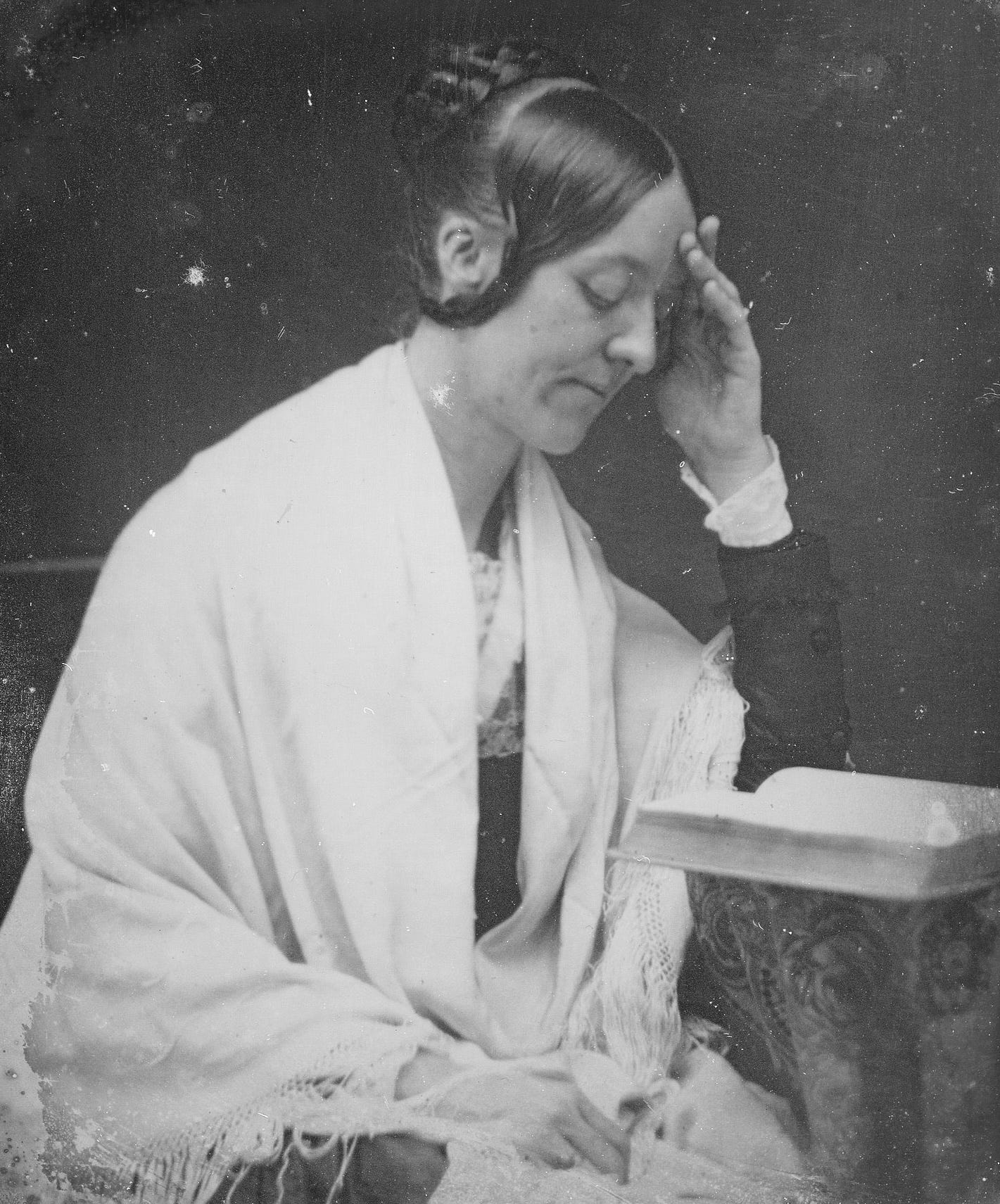
She then had some years of formal schooling, including two years at the delightfully named School for Young Ladies. Upon returning home she continued her voracious reading and taught herself several more languages so she could read European literature. She was considered the most well-read person in New England, and was the first woman allowed in the Harvard library. Her life, her writing, and her legacy were built on a foundation of books.
Jorge Luis Borges mused that “I have always imagined that Paradise will be a kind of library.” In the small picturesque town near our farm, our library is the most beautiful building. It is situated on the village green and it is the heart of our community, a basilica for the brain. It is a temple for the material that lives between our temples. I agree with the line of appreciation attributed to the great Greek philosopher Heraclitius, “I am what libraries and librarians have made me.”
Epictetus advises, “Don’t just say that you’ve read books, show that through them you have learned to think better, to be a more discriminating and reflective person.” I try to follow this maxim by making notes, reflecting, and sharing what I have read. In writing this article, I am following Epictetus’ advice.
What books have shaped and delighted you? Let us know in the comments.
I miss reading. 2026 goal read more fiction and philosophy.
Back in the 1990s, there was a homeless guy in Tribeca who sold books out on the street. Whatever was bouncing around inside my head, Dale would have a book about. It didn't matter how obscure or esoteric the subject.
The City proposed a ban on kite flying in the park by the Verrazano Narrows Bridge. Vernon and I were talking about protesting the ban by flying white kites, but where to get the kites? Dale had "Kites and Kite Flying," with detailed instructions on making kites from stuff you probably had in the house. Then, I was talking to a high school buddy about the presence of the Mafia in our hometown when we were growing up: Dale had "The North Avenue Irregulars," written by a minister in our town who organized a bunch of housewives to fight them off (Disney made a terrible movie based on it). Neither of us had ever heard of this book, but there it was. Another friend was telling me about "Confessions of a Dangerous Mind," which I had never heard of. Dale had a first edition, signed by Chuck Barris, with an inscription saying that "the guys who made Wall Street" were going to be making a movie based on it.
This happened many, many times. I had never seen any of these books in any bookstore. I always bought them for whatever price Dale asked. As I trundled off down Church St., my nose buried in my new acquisition, I would hear Dale giggling and cackling behind me.