
THE BUTTERFLY EFFECT
It's time to spread your wings.


I’m a social butterfly who likes to flit from lunch to a dinner party to early breakfast with friends at the Bonbonniere, the best greasy spoon in New York City. I find my life is better with my good friends. The Stoic philosopher Epictetus said “The key is to keep company only with people who uplift you, whose presence calls forth your best.” When I am with my friends I am borne aloft.

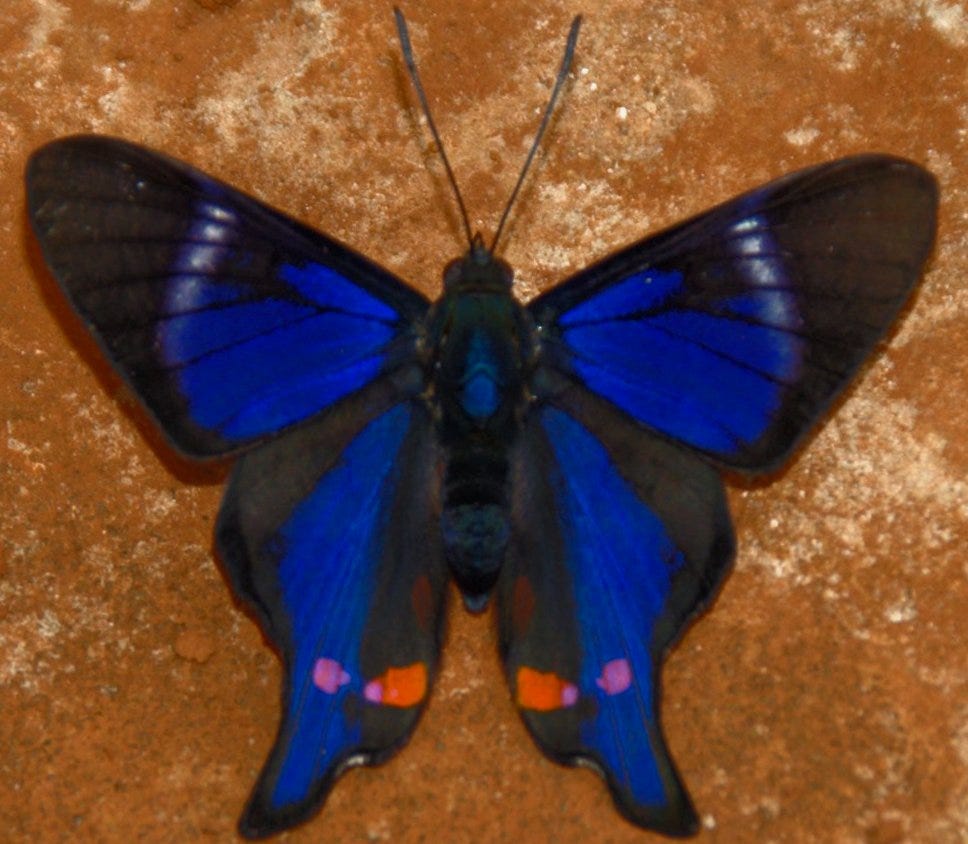
Caterpillars undergo a nearly complete transformation in the course of their lives. This is called holometabolism. When a furry caterpillar reaches maturity, it creates a hard shell around its body called a chrysalis. Inside the chrysalis, the caterpillar begins to decompose into a broth of the lyrically named “imaginal cells.” These cells carry the blueprint of the future.
In the chrysalis, the cells begin to re-assemble and recompose into a new form. When the new body is complete and ready, the miraculous insect cracks open the chrysalis with its legs; this is called “eclosion.” What emerges is a butterfly.
When you go through a tough season, there’s a tendency to wall yourself off and withdraw. This can be a valuable response, a way to focus on what’s important and avoid distractions. When the crisis is past, it’s time to recompose yourself and eclose. It can be scary. Yet as Marcus Aurelius, the Roman Emperor and Stoic philosopher wrote, “Frightened of change? But what can exist without it? What’s closer to nature’s heart?”
If you jimmied open a chrysalis, which you shouldn’t do, you would see a few tiny structures remaining from the creature’s life as a caterpillar, such as the feet. It is a complex and major transformation but not a total one. There is even evidence that butterflies can retain the caterpillar’s memories. As you emerge from your chrysalis, what will you retain? Ask yourself, who are you now? What will you leave behind? And what will you bring with you?
When faced with such big questions and uncertain times, I look for guidance in my philosophical practice. A life philosophy is an attitude, it is your vision for your life. It is your purpose. It is a framework that helps you shape your life. It holds me together in troubling times and guides me in times of uncertainty.
For the past two decades I have found strength and solace in my daily habit of reading the Stoic philosophers. Epictetus, one of the wisest and wittiest Stoics who has ever drawn a breath, said that “If your choices are beautiful, so too, will you be.” This lit me up like a jar full of fireflies. The simplicity and clarity of Stoic wisdom is transcendent. If I were the type of person who used needles and ink to permanently apply words and symbols on my body, this quote would be my tramp stamp, right above the always-popular butterfly tattoo.
The Stoic philosophers believe that life is not against us, but for us. The obstacles we face are infused with opportunities. It is in our power to choose how we will react. Epictetus reminds us that “The trials you will encounter will introduce you to your strength.” I find inspiration to live life with deeper meaning and this ancient wisdom helps me cope with modern struggles.
Times of introspection and withdrawal are an opportunity to examine my life more closely. The first microscopes were called “fly glasses’‘ because they were used to study small insects. In the words of early microscope builder Peter Borell, “a flea is enlarged to the size of a camel, and a fly to the size of an elephant.” Stoicism is my butterfly glass as I take close inventory of my life and magnify myself to the size of a whale. Not all parts of me are flattered by this treatment.
If you look at a caterpillar under a microscope, you’d see that they don’t have a backbone. They are invertebrates. During their transformation in the chrysalis, butterflies grow a sturdy exoskeleton to support themselves. Stoicism is my exoskeleton, a strong philosophical scaffolding that supports and inspires me. My exoskeleton gives me resilience in the face of events beyond my control.
The metamorphosis of caterpillars into butterflies inspires me to reflect on the fact that we will all go through times of darkness and we can emerge as something beautiful. I am grateful that I can deepen my understanding of and connection to Stoicism, because I rely on it when I re-emerge into the world.
The “butterfly effect” is a poetic expression of chaos theory, the concept that infinitesimally small actions can cause world-changing events. MIT professor Edward Lorenz gave rise to the name when he posed the question, “can a butterfly flapping its wings in Brazil cause a tornado in Texas?” For Lorenz, chaos theory is written on the wings of fluttering insects. A titanic occurrence is birthed in a microscopic action. From one tiny movement an immense result can occur.
Not long ago our whole world was upended by a microscopic thing, a virus, a bug. The pandemic was heartbreaking. But in this heartbreak was an opportunity to make changes in ourselves, to revise and do better. We always have the possibility to improve, reinforce values we want to keep, leave behind what is unnecessary, and find opportunities in new beginnings. In words attributed to Seneca, the Roman Stoic philosopher and politician, “Every new beginning comes from some other beginning’s end.”
We are survivors. Let’s embrace it. Marcus Aurelius led the Roman empire through perpetual war and years of plague. He kept a journal of his thoughts, which are preserved in a book we call “Meditations.” He was a man with the weight of the world on him, yet his philosophy has been aptly summarized as, “When you arise in the morning, think of what a precious privilege it is to be alive - to breathe, to think, to enjoy, to love.” We have all of these things before us. Caterpillars eat leaves, which is fine if you’re in the mood for a salad, but butterflies drink the sweet nectar of flowers. Let’s take off and find the sweetness in life.
When you’ve been through a lot and have had to make a lot of changes, it can seem daunting to have to remake ourselves again. But it is necessary. Maya Angelou said that “We delight in the beauty of the butterfly, but rarely admit the change it has gone through to achieve that beauty.”
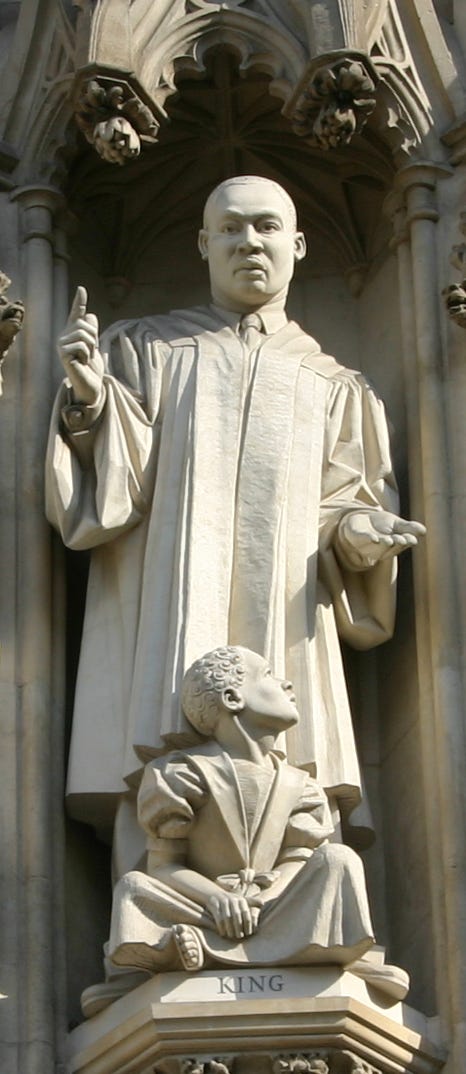
Change doesn’t happen when everything is going fine. Things change because they have to change because they aren’t working. Take heart, you can do it. The butterfly effect shows us that great changes can come from small actions. Martin Luther King Jr. said, “Take the first step in faith. You don’t have to see the whole staircase, just take the first step.” You can begin now. It’s time to fly, you’ve earned your wings.
Well said!