
THE CENTIDAY FRIDAY FIVE: GREGORY B. SADLER
The philosopher as metalhead.


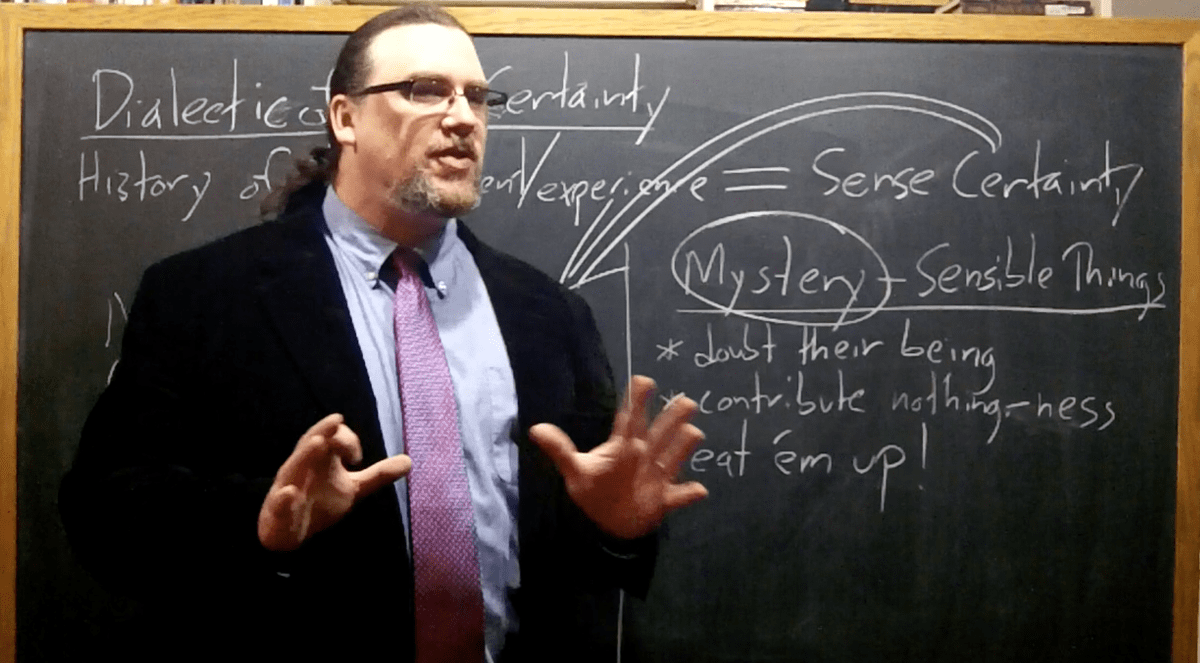
Today’s preferred indifferent on the Centiday is our interview with Greg Sadler. Greg is an author, professor, pillar of the modern Stoic community, and metalhead. He has been studying philosophy for more than three decades, and teaching philosophy for 25 years. He also started the philosophy-focused business ReasonIO.
He is a member of the faculty at Milwaukee Institute of Art and Design. He produces philosophy videos in his main YouTube channel (over 3,500 so far), is a member of the Modern Stoicism steering committee, and was editor of Stoicism Today from 2016-2023.
Greg and his wife Andi live in downtown Milwaukee, Wisconsin.
1. As a philosophy professor, what’s the most surprising thing you’ve learned from your students?
I’ve been teaching philosophy, as well as a variety of other subjects (religious studies, literature, writing), now for 27 years, so not only can I say that I’ve had a vast number of interactions with students, but I also have to admit that I’ve likely forgotten a far greater number of those than the ones I remember. And since there have been countless surprises over the years, there’s a strong possibility that the most surprising ones number among those I’ve forgotten! Rather than focusing on one particular interaction that was surprising, I think I’ll say something about a broader dynamic that it took me a while to wrap my head around. I’ll call it a “virtuous cycle” in education, both in the classroom and online.
Most of my academic teaching has been in what we call “service classes.” These are the sort of “core” or “general education” courses that students are required to take, which only very occasionally satisfy any requirement for their major. It’s rare for me to have any philosophy majors in those classes. Think Intro to Philosophy, Critical Thinking, general Ethics, or Logic courses, as well as various applied or professional ethics courses like Medical Ethics or Business Ethics. You’ve generally got a mix of students from different backgrounds, with varied levels of interest and diligence, majoring in most of the fields the institution offers. For many of them, it is their very first and perhaps only philosophy course they will take. Most have no idea what “philosophy” might mean. Some are anxious, imagining it is going to be very difficult and abstract, worried about whether they’re up for it. Many of them would rather not be devoting that time to a subject and to topics they don’t see any payoff for in their life or studies.
I basically stumbled into a productive approach (I won’t say the only possible right approach) to those students early on in my teaching career. It accomplishes a number of different things that we want to occur in college or university education. I don’t water down the curriculum as some instructors are tempted to do, thinking they’ll more easily reach the students “where they’re at” by selecting much easier texts. I have my students read selections, sometimes entire works, by classic and contemporary thinkers. I also stress to those students that every single one of them, whether they feel themselves up to studying the real deal philosophical works, is indeed capable of reading and understanding them, provided they get some needed support. And that support is what they get in my classes, both through the many resources I’ve developed for them (lesson pages, handouts, videos, just to name a few), and focused class sessions where we work through the texts and apply the concepts to many examples taken from their day-to-day lives or their majors.
It’s not 100% guaranteed (what is?) to work with every class of students, but generally what happens is the development of a virtuous circle. I hold the students to high expectations, but I tell them I have confidence they can meet them with support, and I provide them that support. That not only eases a lot of anxiety and removes some of their reticence to contribute in class. More positively it gives at least some of them a sense that we’re engaged in something important for them, that they’re getting an opportunity to study something worthwhile, and that they’ve got an experienced leader who cares about not just the material but them as persons, their ideas and experiences, their development, and their later careers. And that in turn tends to make them more willing to work, not to be merely passive consumers in the class, to make an effort to contribute on their ends. That generates classes that are typically enjoyable and engaging for at least most of us on any given day. And over the course of the semester, the cycle repeats, which tends to help the matters we studied stick in their heads better after our course time together is finished.
Now, why is that a surprise? Really for two main reasons. First, as I wrote earlier, I just sort of wound up doing things that way, and it paid off well for me and the thousands of students enrolled in my courses over the years. Second, I’ve noticed that that sort of approach, and that kind of virtuous circle, is unfortunately not all that common in higher education. I’ve had many philosophy colleagues over the years who really dislike and disvalue teaching those service classes, framing them as essentially wasting their time slumming with people who will never really care about philosophy, just to earn a paycheck. I’ve talked with many people who took an Intro to Philosophy or Ethics class, and said that for one reason or another it was not a good experience, and when we’ve discussed it further, at least a significant responsibility for that clearly fell on the instructor’s shoulders. So it’s a surprise to me that people who claim to care about their field, its grand ideas, great writers and texts, wouldn’t want to foster an interest in it and appreciation for it with as many students as possible.
2. You’ve written about your recent accident and the aftermath. Is Stoicism helping with your recovery? Do you use a crutch like Epictetus, or a cane?
I’m still four months later using a cane, but only when I have to walk some distance, and mainly because my medical staff haven’t entirely cleared me to leave it behind. I’m hoping to put it away in storage before too long. Just so people know what we’re referring to, I had a rather freak accident, fell just right on a hardwood floor and shattered what they call the “head and neck” of my right femur. So I had to have an emergency hip replacement, which due to the trauma and other circumstances is a bit unlike, a bit more intense than, the usual hip replacement surgery people might have in mind. There was a good bit of healing, adjustment, and physical therapy required afterwards.
I suppose that Stoicism has helped with my recovery, though not in any sort of direct way. I’m not knocking anyone for whom this helps, but I don’t usually bring up quotes for myself in particular situations to provide guidance on how to get through them. It’s more like I’ve been rereading and sometimes teaching or referencing Stoic texts and thinkers for so long that after a while I found my attitudes, mindsets, priorities, reactions and what I focus upon wind up changing along lines that are, let’s say, in accordance with Stoicism. When the accident happened, immediately accompanied by a lot of pain and loss of mobility, soon after involving time in the emergency room, being transported and contorted for x-rays, a somewhat bumpy ambulance ride over to the main medical campus, lots of explanations and questions from doctors and nurses, and then the surgery itself and the aftermath, my reactions to everything were surprisingly reasonable.
The pain was the pain, not the worst I’ve ever felt, but pretty intense, but I was able to view it in context of what happens when you’ve got a body, you wind up doing serious damage to it, and pretty significant interventions and alterations are the only prudent remedy. For someone used to walking four to five miles a day, having to laboriously use a walker just to move around a hospital room or later in our small living space could feel demoralizing. That, too, I was able to respond to in a way that kept things in proportion. I was entirely dependent upon the medical staff and my wife in the hospital and then just my wife for about my first week at home, and for someone accustomed to a lot of independence and used to long work weeks, that likely would have been a lot tougher for me years back. But studying and practicing Stoicism for years, again not in any direct manner, prepared me well to deal with the new, non-ideal circumstances well.
3. What drew you to Stoicism?
Originally, it wasn’t so much Stoicism I was drawn to as to two Stoic authors. One of them, Epictetus, I ran across back in college, when we read his Enchiridion as the only Stoic text in an Ancient and Medieval Philosophy class. I also got a copy of Marcus Aurelius’ Meditations my first year in college and read through it, though I was mainly interested in him as a military commander. So I didn’t get much out of those first encounters with Stoicism. It was only later on in graduate school and then early on in my teaching career, that I made my way back to Stoicism. In a used book store, I found a copy of Epictetus’ Discourses, and as I was reading around in it I realized that he was discussing a number of matters having to do with choice, habits, motivation, and self-improvement that I had become particularly interested in. So I bought the book and read through it multiple times, just in the English translation back then (though by that point in grad school, I was reading Plato and Aristotle in Greek).
In my last few years in graduate school, I became very interested in what ancient and medieval philosophers could contribute to understanding and managing anger. I had been struggling with my own issues with anger since my childhood, and I’d seen quite a bit of what psychotherapists and psychologists had to say about that, a good bit of which was rather shallow and sometimes even counter-productive. And at the same time, by reading widely in philosophy, I was seeing that philosophers had worked out pretty robust approaches to that emotion, but that most people interested in philosophy weren’t reading the parts of their texts that dealt with and developed their theories and practices. You can well imagine that sooner or later I’d find out that Seneca wrote an entire work On Anger, and I’d read it. In fact, that was the first work of his I engaged with.
When I study a philosophical thinker or school, my general approach is to read around in the available texts, looking not just for some main ideas, but trying to build up in my own mind a picture of the complex interconnections between not just some main ideas but all the stuff we find in those works. Decades back, I coined an off-the-cuff name for that approach, which I call “philosophical detective work”. It’s definitely not a common approach in philosophy, but it can be incredibly rewarding to practice, and for schools like the Stoics, where you have thinkers who are writing in two different languages (Greek and Latin), often saying things that don’t easily map onto each other, it can be a very productive way to study and to present them. That’s the approach I’ve been taking with Stoicism for years.
I’ll give you one example of what I mean. We know that virtue is centrally important for the Stoics, and that, like most of the other ancient schools, they identify four main “cardinal” virtues: prudence (wisdom), justice, temperance, and courage. That’s unfortunately where a lot of would-be Stoics stop in their studies and understanding. As it turns out, each of those four cardinal virtues encompasses a number of “subordinate” virtues as well. So you can’t really know what classic Stoics meant by temperance, for example, if you just gloss it as “self-control” or “moderation”. You have to actually go see what the Stoic texts say about the full range of the subordinate virtues falling under temperance. Now Arius Didymus actually gives us some listings and brief explanations of what the subordinate virtues are, but he’s just one starting point, and unfortunately some people stop there. If you want to reconstruct and thereby really understand the full range of the subordinate virtues, you have to read across pretty much the entire body of Stoic literature as well as literature not by Stoics but about them. And to be honest, you also have to go back to the Greek and Latin, not just relying on translators. Doing precisely that with Stoicism and the virtues is a project I’ve been engaging in now for about five years, offering classes and seminars, producing videos, writing posts, producing resources, and working on two book-length projects on that topic.
To return to the original question, since you might say that I’ve ranged pretty far afield of what drew me to Stoicism, I can say that there’s an answer to what initially got me into Stoicism, and then there’s an answer about what continues to draw me in, differently and more deeply, in the present.
4. You host a heavy metal YouTube show. Can you think of an ancient Stoic who would have been into metal? If so, what would their favorite band be?
Yes, my good friend and colleague, Scott Tarulli, a guitar professor at Berklee School of Music and a great musician in his own right, and I co-host a more or less monthly Classic Metal Class. We started it years back, because in our conversations about much more academic matters, mostly philosophy and rhetoric, he and I were constantly using stuff from heavy metal as examples we’d apply the theories to, and then going off on tangents together about bands, songs, musicians, and the like. So as two metalheads since childhood, we decided to pool our talents and start up that class. Now about ancient Stoics who would have been into heavy metal, that’s a tough one, because I think that temperamentally none of the authors we read (like Seneca or Epictetus) or at least read about (like Zeno or Posidonius) would probably have been into heavy metal. They likely would view it as a bit excessive musically, and perhaps would regard many of the lyrics and themes, let’s just say, unedifying.

So you might well wonder whether there could be some tensions, even contradictions between being a Stoic but also not just being a longtime listener to heavy metal but someone who takes that musical genre seriously enough to devote thought and discussion to it. There’s a very straightforward response I can make, which is that I don’t actually claim to be a Stoic, but rather an eclectic like Cicero, someone who embraces a good bit but not every aspect of Stoicism and integrates it with other robust philosophies as ways of life. But that doesn’t really address the concern about Stoicism and heavy metal perhaps being out of sync for each other. I will say that there are some metal bands, musicians, songs, lyrics, lifestyles, even perhaps certain sub-genres where you’re probably not going to productively bring them together without outright contradictions. The bleakness and nihilistic pronouncements of certain black metal bands, the advocacy of hedonism above all else of others, that’s not going to fit with any genuine Stoicism. Other bands, and Triumph is the first and foremost one that comes to mind, I think are not just compatible with Stoicism but perhaps without meaning to even exemplify it.
5. How can modern Stoics strike a balance between updating the philosophy for our world, while remaining true to the core principles?
I suppose the first thing one would need to do in order to work that out is to find out for oneself what the actual core principles of Stoicism are. One common encounter I have is with people interested in Stoicism, who have studied it a bit, and think that they’ve figured out what Stoicism’s core principles are, but end up being mistaken about them. Sometimes it’s not entirely their fault that they’ve been misinformed. They trusted some popular author who led them astray, who might themselves have views about Stoicism that are at odds with what the actual classic Stoics tell us. There’s a lot of these, so I’ll just give one prime example. Stoicism teaches that “virtue is the only good,” right? Well. . . no. You can find that formulation in a very few places in Stoic texts. Much more often you’ll see “virtue and what participates in virtue is the good”. But you’ll also find a number of general or specific things that are not themselves virtue explicitly called “goods” in Cicero, Seneca, Epictetus, Arius, and others. So clearly the “Stoic principle” involved is more complicated than the over-simplified version of it.
So let’s say someone has put in the time to attentively study, to learn what the Stoics actually think about matters, including where some Stoics have one view and others a different view. That person has built up for themselves a good grasp of Stoic principles, and now the issue is how to live those out in a contemporary world. In a lot of cases, it seems pretty straightforward, since many features of our current day society and the world more generally haven’t changed radically. We may live longer, and we may not typically have death and dying as present in our era as they did in the ancient Mediterranean world, but we’re all going to die, and everyone we know will either die before us, after us or at the same time. That’s a for-the-present inevitable feature of the human condition that Stoic philosophy can help us understand.
We might still be subject to many illnesses and injuries that plagued people in the past, as well as some new ones as well, but the discipline of medicine has certainly advanced since ancient times. Does that radically alter how we would apply Stoic principles? Not really, though we certainly have to use them within situations that are very different from ancient times. Some matters of the body that perhaps just to be accepted and dealt with as they are now prove amenable to remedy through surgery, medication, diet, exercise, and many other approaches. And yet, the body does remain an external and indifferent from a Stoic perspective, which we ought to use wisely.
There are a vast variety of matters that play significant roles in our late modern lives that the ancient Stoics didn’t have anything to say about. Dating and the wide range of modern romantic relationships, for example, or social media usage and cell phone, or awareness of the impacts we have upon the global environment. These sorts of matters provide us with opportunities for thinking about the implications for Stoic principles we already understand within new situations, bearing on unforeseen issues and challenges.
There are yet other matters where perhaps we ought to prudently leave behind certain ideas classic Stoics were committed to, for instance, the notion of God as logos permeating the entire universe and providentially ordering it. We have to exercise prudence, an orientation to discerning truth. One might find some way to hold onto that in the present, depending on what one chooses to mix Stoicism up with, but another related notion we likely need to abandon as not just factually unlikely but also of no real use to us is the ekpyrosis, that is, the idea that the universe periodically resolves into elements that are consumed by fire, leaving only God behind, and then it starts all over again.
So it really does depend quite a bit on what Stoic “principles” we have in mind and how we think Stoicism ought to apply to our present-day situations, society, and lives.
Illuminating interview with Professor Sadler.