
THE CENTIDAY FRIDAY FIVE: VANESSA MORGENSTERN
AKA Stoic Dahlia


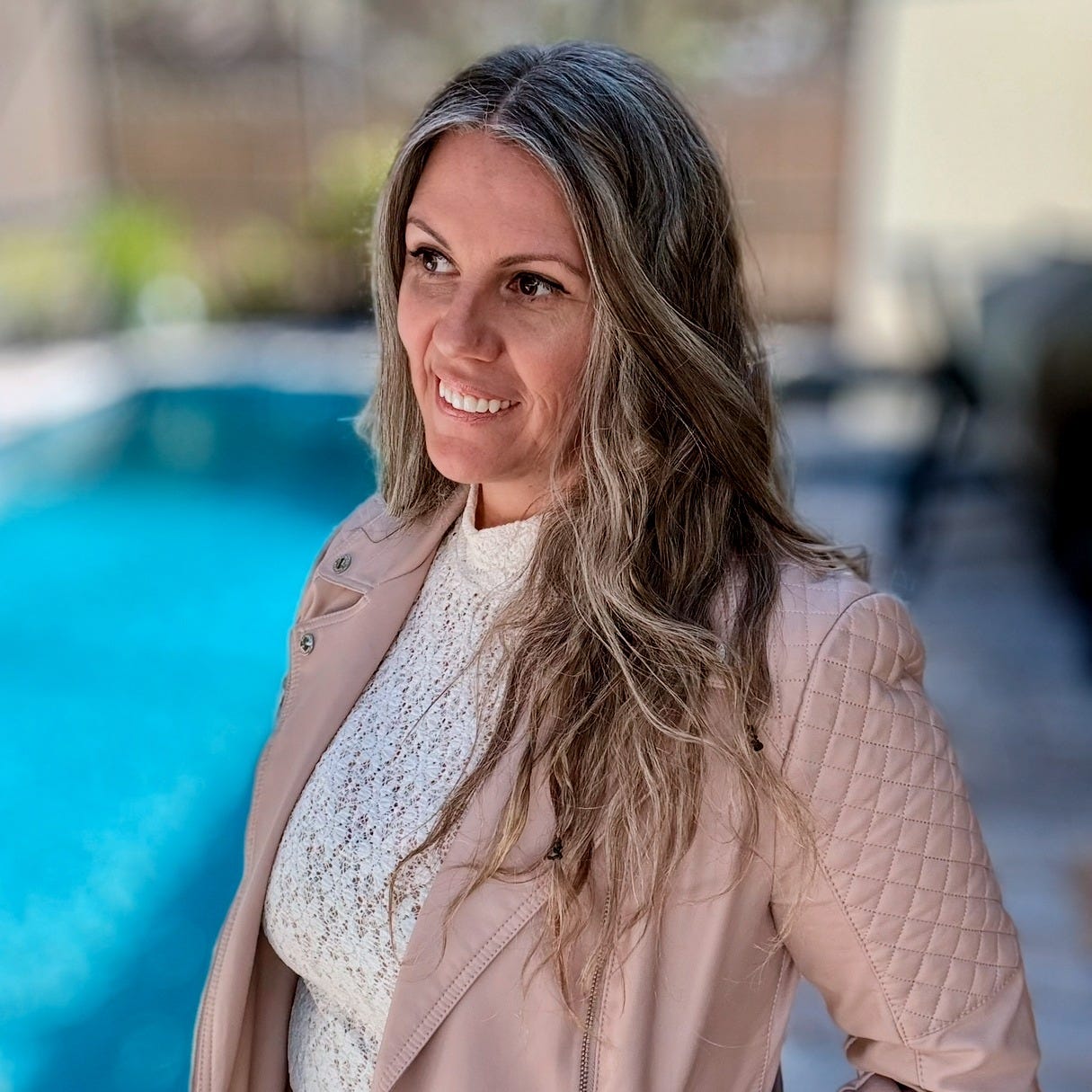
Vanessa Morgenstern is a writer, philosophical practitioner, and founder of Stoic Dahlia, a modern Stoic community for women. Her work approaches philosophy through a female lens, treating it as a lived practice for navigating an increasingly complex world.
She currently writes PhilosoShe™ Weekly, the Stoic Dahlia newsletter published on Substack, where she bridges ancient wisdom and contemporary life through practical reflection, Stoic-inspired exercises, and personal storytelling.
As a dedicated community architect, she also facilitates intentional spaces, including Porcia’s Porch, a private global reflection community. Through guided dialogue and shared inquiry, participants move beyond theory to embody Stoicism in everyday life. We were privileged to meet Vanessa at a Stoic event a few years ago and are looking forward to seeing her again at the Stoic Arts Conference in April 2026.
1. What first drew you to Stoicism?
I was drawn to Stoicism during a quiet but disorienting transition in my life. I had stepped into a season that looked meaningful from the outside, but internally, I was really struggling with what my “sense of purpose” was. I had just had my second child, but it was my first experience as a stay-at-home parent. My days were no longer organized around achievement, productivity, or visible results, and that unsettled me more than I expected. Shame and guilt just piled on top of all of that.
Stoicism challenged me in ways no one in my life ever had. The passages and texts felt like a dialogue, asking me hard questions, helping me realize that I actually had a choice in all of this. In how I think and how I feel.
Over time, it also challenged my belief that worth comes from output, recognition, or constant striving. Instead, it showed me that meaning comes from how we show up in our roles, how we judge things, and how we handle responsibility, especially when no one is watching.
That was something I had never really sat with before. It was the gentle smack in the face, or perhaps the dramatic splash of lukewarm water from a drinking glass, a firm but kind wake-up I needed (if that makes sense).
2. What’s behind the name Stoic Dahlia?
Ha, thanks for asking this. In all the years I’ve carried this name, I’ve only ever shared the full story with one other person.
Stoic Dahlia came from a contradiction I couldn’t unsee.
Before writing and Stoicism, I was an event planner, and I had a love–hate relationship with flowers. I remember tugging at their petals, adjusting blooms, and worrying they might fall apart or die instantly overnight, not making it to the event the next day. But I quickly learned that the common assumption that flowers are delicate and fragile was simply wrong. They are resilient little buggers. And even in decline, they carry a kind of dignity and beauty.
Later, when I encountered Stoicism, I noticed a similar misconception. There was no suppression here. To my surprise, it was the first framework I had come across that treated emotional regulation as a strength, and it truly blew my mind.
So, as I set out to start blogging about my personal journey of practicing philosophy, and feeling like a blend of misconceptions and a walking contradiction myself, Stoic Dahlia was born. The dahlia is a nod to my Mexican heritage, but it also carries a message I wanted to make clear. Flowers are hardcore. And Stoicism is grace under fire.
Over time, the name became a symbol inviting women to better understand themselves through resilience and emotional awareness, especially those who felt out of place in modern ideas of success or moving through constant identity shifts
3. Like you, we’re trying to get more women involved in Stoicism. Why are you driven to do that?
For two reasons. The second came later down the line.
At first, my focus was simply on giving women language and structure to help navigate the hard places in their lives. Early on, I wrote honestly about my life and my own personal challenges, and women immediately started reaching out to say they felt the same way. That my experiences became a catalyst for conversations that they then carried into their families, friendships, and relationships, where something unspoken needed attention.
To better understand myself and the community I was writing for, I spent a lot of time looking at research on women, opportunity, and happiness. What emerged was a clear and exhausting pattern in why fulfillment often feels so hard to reach. Something that was at the base of what I was feeling.
For women, over the years, expanded opportunity has come hand-in-hand with constant role instability, creating deep insecurity and frequent shifts in identity and priorities.
For example, in a relatively short span of time, we’ve moved through a series of conflicting cultural models. From the corporate “lean in” culture to the ultra-hyper-ambition of the GirlBoss era (2018). We then swung through the crisis of the “She-cession,” exposing burnout, later leading to a push for simplicity and authenticity (seen in the de-influencing movement). And now, we are witnessing the prominent rise of “trad wives” and what that narrative looks like today.
Now, men experience this pressure too, of course, but their roles (from the view of society) have remained relatively stable over time. But for women, these rapid cycles have us constantly trying to figure out which version of womanhood is the “right” one to embody.
So it became my belief that if Stoicism helped ground me in that tumultuous space, it could help other women, too. That is my drive, and ultimately, where I get the courage to openly discuss all the ways I’m “re-wiring” the way I think.
But as I worked more closely with women, both those new to Stoicism and those who have been practicing far longer than I have, something else became clear. My second drive: That philosophy needs women, too, something Sharon Lebell has been saying long before I ever put words to it.
So my work has become this cool, living lab, if you will, where I get to witness how women actually engage Stoicism. The way they interpret it, apply it, question it, and bring forward vital issues that force Stoic ideas to be re-examined more honestly. I’m in awe every time I’m in those spaces.
I guess you could say my drive sits at that intersection, bringing philosophy into women’s lived experience while also bringing women’s lived experience into the philosophy.
4. Who’s your favorite Stoic, or what’s your favorite bit of Stoic wisdom?
Epictetus, through and through.
I respond best to tough love, and I feel like Epictetus meets you exactly there. His teaching style is direct, unsentimental, and deeply practical. He doesn’t indulge excuses, but he also isn’t cruel. There’s a clarity and care beneath the firmness.
But I’ve also reflected on why I feel such a strong connection to him, and I think part of it comes from his lived reality. Epictetus was born into slavery, and I want to be clear that I’m not equating modern experiences with that historical brutality. What resonates with me is how his philosophy speaks to the experience of feeling inwardly captive, trapped by fear, resentment, and circumstances that seem to strip you of control.
Epictetus teaches that when you are in that space, you still have a choice. You can live in resentment and self-pity, or you can work with the cards you’ve been dealt and claim agency where it actually exists.
He doesn’t ask you to feel better. He asks you to think better.
His work consistently brings me back to personal responsibility, agency, and the discipline of examining my judgments rather than blaming circumstances. And through that practice, I’ve felt genuinely strengthened and empowered.
5. Who’s your favorite non-Stoic philosopher? It could be anyone from Aristotle to Thich Nhat Hanh to Bill Murray.
Oh man, I really appreciate this question. I genuinely had to pause with it, in the best way.
From the classical world, Aspasia stands out deeply for me. Her home became a center of intellectual life in Athens, and if there’s any truth to the idea that Socrates absorbed what later became known as the Socratic method through her, then she is absolutely my main woman. She represents wisdom expressed through dialogue, presence, and community rather than formal treatises.
I’m also endlessly inspired by Emily Dickinson and all the ways she lived her life, even when thought of as unconventional.
In more modern times, I’ve found insight in writers like Matthew McConaughey, Will Smith, and Gisele Bündchen, which surprised me. I initially encountered their work more as cultural or entertainment figures, not people I expected to learn from philosophically. But reading their reflections on virtue, self-mastery, parenting, and personal growth challenged that assumption.
Their work reminds me not to judge a book by its cover (pun intended). To never judge where wisdom can come from.
Those are just a few names that immediately came to mind. I guess I cast a pretty wide net when it comes to wisdom and what I define as a philosopher. I could have given a much shorter answer by simply saying that my favorite “non Stoic philosopher” is anyone who lives their values consistently over time. And if we’re lucky, we get access to their journals, poetry, or reflections, small windows that help us live a little more thoughtfully ourselves.
Bonus question: What should we have asked you, and what’s the answer?
The question I’m asked most often, and one I think is important to address openly, is: “Why create a separate space for women when the principles of Stoicism are universal?”
I genuinely appreciate this question, as more often than not, it comes from a place of curiosity. But at times, it has also come from a place of doubt. So I want to address the elephant in the room directly if I may.
The intention behind creating female spaces like Porcia’s Porch (my Stoic community for women) has never been about creating an “us versus them” mentality. It came from a place of investment in the philosophy itself.
When I began this work, it honestly never crossed my mind that I might be creating a divide or that some would even think that. I’ve never questioned the universality of Stoic principles. Wisdom, justice, temperance, and courage belong to everyone, indeed. The philosophy itself is not gendered.
What I’ve come to understand over time, though, is that the path to applying those principles is not universal. And sadly, many women walk away from Stoicism not because the philosophy failed them, but because they lacked the right community and context to learn within.
Through our gatherings, I feel like we have begun to identify where some of the barriers lie. There is a conditioning gap for sure, but there are also real nuances around roles and duties that can make it harder for women to translate or adapt Stoic ideas into their actual lives. The work beyond the basic tenets often lands differently.
That’s where a woman’s space becomes useful. It creates the room to slow down and ask personal questions without judgment.
“What does this Stoic principle actually mean for me?”
“What does my role look like when societal expectations are constantly changing and demanding an ongoing reckoning with personal identity?”
I believe that when a woman can share honestly how Stoicism works in her life, even when her application looks different from the man sitting next to her, she develops a grounded sense of self-possession. And when she brings that clarity into shared philosophical spaces, it doesn’t create separation. It brings depth, nuance, and rigor to the conversation. Which I think ultimately strengthens the philosophical community as a whole.
***
We’re thrilled and grateful that Vanessa was kind enough to share these extremely thoughtful responses. What drew YOU to Stoicism? Let us know in the comments!
Thank you for sharing your insight with our community. I'm with you, Epictetus is my main man, too.
Thank you so much, Karen and Francis, and Vanessa, for this great interview, and for all of the wonderful work that you are doing! I really appreciate all that you are doing.!